Before Trains Ran on Schedule, Nobody Did: How America Learned to Feel Guilty About Being Five Minutes Late
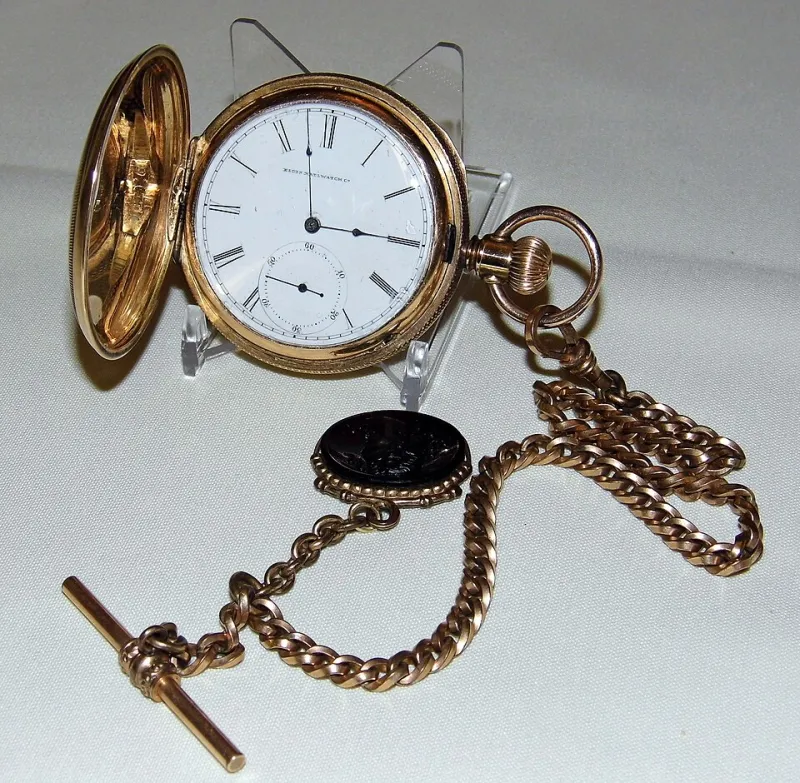
Photo: Joe Haupt from USA, CC BY-SA 2.0, via Wikimedia Commons
If you arrived at a friend's farmhouse in rural Ohio in 1820 and apologized for being late, your host would have been baffled. Late by what, exactly? The sun rose when it rose. The harvest took as long as it took. Time, for most Americans, wasn't something you could be late to — it was something you lived inside of, like weather.
Today, you can feel your pulse spike when the meeting invite says 2:00 and it's 1:58. That anxiety wasn't natural. It was built — sold, actually, one pocket watch at a time.
The Sun Didn't Punch a Clock
In the early republic, time was local in the most literal sense. Every town kept its own noon, based on when the sun hit its highest point over that particular patch of ground. Philadelphia and New York — a short train ride apart today — ran on clocks that disagreed by several minutes. Nobody cared. There was no reason to care. Appointments were vague by design: "come by in the morning," "after the fall harvest."
The rhythms of life belonged to the seasons, not the second hand. Farm work surged at planting and harvest and slackened in between. The idea that a person's day should be divided into standardized, sellable chunks would have sounded strange, even insulting.
What changed everything was steel on rails.
The Railroads Break Time
A locomotive moving at 30 miles an hour cannot afford ambiguity. If every town runs on its own local noon, scheduling a train is a nightmare of conversion tables and guesswork — and occasionally a head-on collision, which is exactly what happened with alarming frequency in the mid-1800s.
So the railroads did something audacious: in 1883, they simply divided the country into four time zones and declared them into existence. Standard time wasn't passed by Congress. It wasn't voted on by the public. Private companies, tired of crashes and chaos, rewrote how Americans experienced the day.
Newspapers grumbled that God's time was being replaced by railroad time. But the trains ran on schedule, and the schedule won.
Factory Whistles and the Morality of the Minute
Meanwhile, a second force was reshaping how Americans thought about time: the factory. A mill owner couldn't pay workers by the season. Labor had to be measured in hours, and hours demanded attendance — hence the whistle, the time clock, and the growing sense that arriving late wasn't just inconvenient but wrong.
Punctuality got folded into the era's ideas about character. Being on time signaled discipline, reliability, respectability. Being late suggested something worse than disorganization — it suggested a defect of the soul. Horatio Alger-style success stories made a hero's punctuality a plot point. Timekeeping became a virtue, and virtues can be marketed.
Enter the watch salesmen.
Selling the Pocket Watch — and the Guilt That Comes With It
In the decades after the Civil War, American watchmakers — most famously the Waltham and Elgin companies in Massachusetts and Illinois — industrialized watch production and drove prices down from luxury-item territory to something a clerk or a farmer could afford. The railroads helped here too: conductors and engineers were required to carry certified, accurate watches, which made the watch itself a symbol of serious, modern manhood.
Salesmen fanned out across the country with a pitch that was less about gears and more about identity. A watch wasn't a tool; it was proof you were somebody. Advertisements of the era leaned hard on the fear side of the equation, too — the embarrassment of keeping a client waiting, the deal lost to a missed appointment. The industry didn't just sell timepieces. It sold the anxiety of being without one.
By 1900, the cheap American pocket watch had put standardized time in millions of vest pockets. A habit that had taken a few thousand years of human history to develop — living by the sun — was dismantled in a single generation.
Why You Still Flinch at 1:58
The wristwatch, the alarm clock, the punch card, the Outlook notification — each layered another coat of paint on the same structure the railroads and watchmakers built. We still live in it. The meeting that starts at 2:00 sharp, the shame of the late arrival, the reflexive "sorry I'm running behind" — these are cultural artifacts, manufactured in the 19th century and inherited like furniture.
None of this means punctuality is bad. Coordinating millions of strangers requires shared time, and showing up when you said you would is a kindness to others. But it's worth remembering that the sting of lateness isn't a law of nature. It's a story we were told — by people selling trains, shifts, and watches.
The sun, for what it's worth, has never once cared.