The Week That Changed How America Sees Yellow
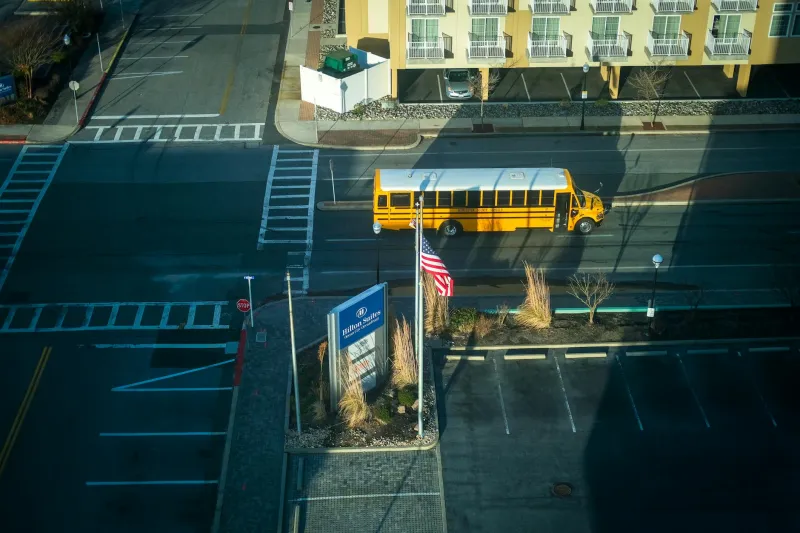
Every weekday morning, 26 million American children climb aboard vehicles painted in a color that technically doesn't exist in nature. The shade we call "school bus yellow" isn't found on any flower, sunset, or mineral formation on Earth. It was invented in a laboratory, refined through psychological testing, and standardized by committee — all in the service of making sure kids get home safely.
The story begins with Dr. Frank Cyr, a rural education professor at Columbia University who had grown frustrated with America's haphazard approach to student transportation. In 1939, school buses came in every color imaginable — red, blue, white, even polka-dotted vehicles roamed American roads. Some districts used converted farm trucks. Others relied on whatever local contractors happened to own. The result was chaos: buses that broke down regularly, drivers with no training, and vehicles so poorly marked that emergency responders couldn't identify them during accidents.
The Conference That Rewrote the Rules
Cyr decided to fix the problem through what he called "democratic standardization." He invited 35 transportation officials, school administrators, and paint manufacturers to Columbia for a seven-day conference in April 1939. The goal wasn't just to pick a color — it was to create an entirely new set of national standards for school transportation.
But the color question dominated the discussions. Cyr had been studying visibility research conducted by the military and highway departments. He knew that certain colors registered in human peripheral vision before the conscious mind processed them. Red was too associated with emergency vehicles. Orange wasn't widely available in durable paint formulations. Blue disappeared in twilight conditions.
Yellow, however, had unique properties. The human eye processes yellow faster than any other color in the spectrum. It remains visible in fog, rain, and the dim light of early morning or late afternoon when most school buses operate. But not just any yellow would work.
Engineering the Perfect Shade
Working with paint chemists during the conference, Cyr's committee developed what they officially named "National School Bus Chrome Yellow." The formula was precise: a specific mixture of chrome yellow pigment with carefully measured amounts of red and orange tinting agents. The result was a color that appeared almost orange in bright sunlight but maintained its yellow properties in low-light conditions.
The shade was designed to trigger what psychologists call "pre-attentive processing" — the brain's ability to notice and categorize visual information before conscious thought occurs. When you glimpse a school bus in your peripheral vision, your brain identifies it as a school bus before you've actually turned to look at it.
The Standardization That Stuck
By the end of the conference, Cyr's committee had established 44 different standards for school buses, from the color and placement of warning lights to the height of seat backs. But it was the color standard that proved most enduring. Within five years, nearly every state had adopted National School Bus Chrome Yellow as their official requirement.
The timing was crucial. World War II created massive demand for standardized manufacturing processes, and the federal government was already pushing for uniform standards across industries. School bus yellow rode this wave of wartime efficiency, becoming embedded in state regulations and manufacturing specifications.
Why It Never Changed
Eighty-five years later, the color remains virtually unchanged. Attempts to modify it have consistently failed — not because of bureaucratic inertia, but because the original formula works exactly as intended. Studies conducted in the 1970s and 1990s confirmed that National School Bus Chrome Yellow remains the most visible color for large vehicles under the widest range of lighting conditions.
The color has become so associated with American childhood that it transcends its practical purpose. School bus yellow appears on everything from pencils to lunchboxes, serving as visual shorthand for education, safety, and the ritual passage of growing up in America.
The Accidental Icon
What Dr. Cyr created in that Columbia conference room was more than a safety standard — it was an accidental piece of American iconography. The color that emerged from his week-long committee meeting now appears in roughly 480,000 school buses nationwide, making it one of the most consistently applied design standards in American life.
Every morning, that invented shade of yellow carries children to school, its specific wavelength engineered to catch the attention of distracted drivers and register in peripheral vision before conscious thought occurs. It's a color that exists solely because one professor decided that American children deserved better than riding to school in whatever vehicle happened to be available, painted whatever color seemed convenient.
The next time you see a school bus, you're looking at the result of seven days of democratic decision-making, psychological research, and chemical engineering — all compressed into a single, unmistakable shade of yellow that never existed until someone decided it needed to.