The War That Taught America to Stop Shopping Every Day
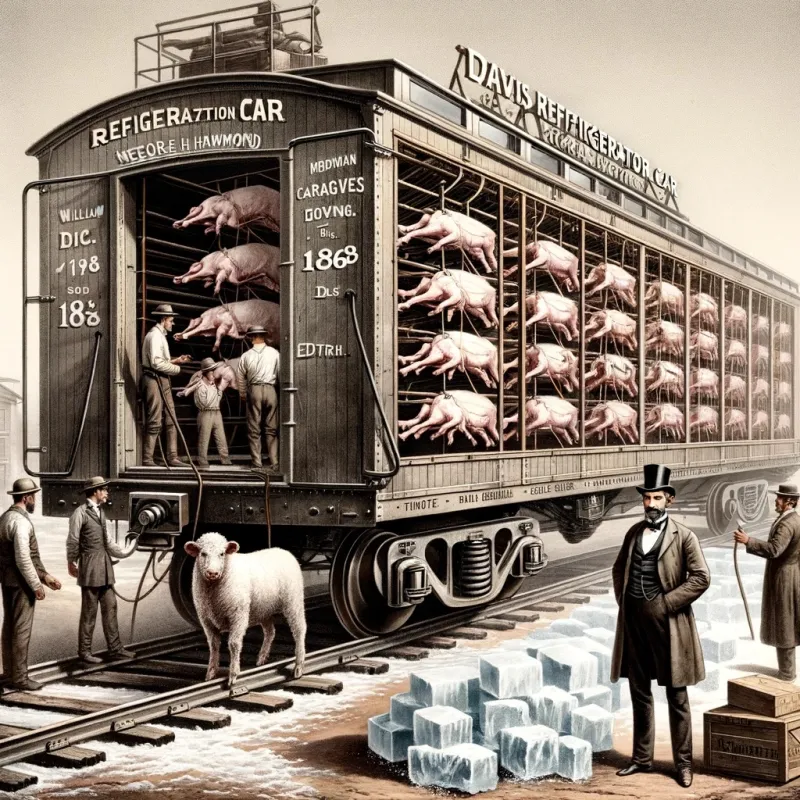
Photo: vintage refrigerated train car railroad historical black and white, via todayinrailroadhistory.com
Walk into any American grocery store today and the refrigerated section runs the length of the building. Dairy cases, produce misters, meat counters, frozen food aisles — the entire architecture of the modern supermarket is built around the assumption that cold equals fresh, and fresh equals safe. Americans fill their carts with a week's worth of food without thinking twice about whether any of it will survive until Thursday.
That assumption didn't always exist. For most of American history, it would have seemed not just unusual but impossible.
When Fresh Meant This Morning
Before the Civil War, the American food system operated on an almost entirely daily basis. Families in cities bought what they needed from local markets each morning. Meat was purchased from butchers who had slaughtered the animal that day. Milk arrived by cart and was consumed quickly because it had nowhere safe to go. Vegetables came from nearby farms and were cooked before they had a chance to turn.
Ice was available in wealthier households — harvested from frozen ponds in winter, packed in sawdust, and stored in insulated ice houses — but it was expensive, inconsistent, and not something ordinary families built their food habits around. The concept of buying groceries "for the week" simply didn't map onto the reality of how food was stored and transported.
Refrigeration, in any meaningful commercial sense, didn't exist. Cold was a seasonal luxury, not a supply chain.
The Logistical Nightmare of Feeding an Army
When the Civil War broke out in 1861, the Union Army faced a problem that had no real precedent in American history: feeding hundreds of thousands of soldiers spread across thousands of miles, in climates ranging from the swampy heat of Louisiana to the bitter winters of Virginia, while also trying to keep field hospitals stocked with medical supplies that deteriorated rapidly in the heat.
The scale of the operation was staggering. At its peak, the Union Army had more than a million men under arms. Each one needed food. Each field hospital needed medicines, bandages, and increasingly — as military surgeons began to understand the importance of keeping wounds and amputated limbs cold to slow infection — ice.
Military surgeons during the Civil War were working at the brutal frontier of American medicine. Anesthesia was new. Antiseptics were barely understood. Infection killed more soldiers than bullets did. Surgeons who recognized that cold slowed bacterial growth began requesting ice shipments with the same urgency as morphine. Ice became a medical supply.
This created enormous pressure on Union logistics officers to figure out how to move ice and perishable goods over long distances without losing them. The answers they developed were improvised, imperfect, and frequently disastrous — but they pointed toward something important.
The Railcar That Changed Everything
The key technological breakthrough didn't come from medicine. It came from a meat packer.
In the years immediately following the Civil War, a Detroit businessman named William Davis patented a refrigerated railcar design in 1868 that used metal racks to suspend carcasses above a compartment packed with ice and salt. The car was crude and had serious problems — the ice melted unevenly, the temperature was difficult to control, and the whole thing required constant restocking at ice stations along the route.
But it worked well enough to prove the concept.
A Chicago meatpacker named Gustavus Swift took that concept and, in the late 1870s and early 1880s, turned it into an industry. Swift invested heavily in improved refrigerated railcar designs and, crucially, built a network of ice-stocked transfer stations along rail routes so that cars could be re-iced as they traveled. He could now slaughter cattle in Chicago, load the dressed beef into refrigerated cars, and ship it to New York — arriving fresh, cheaper than locally sourced meat, and in quantities that local butchers couldn't match.
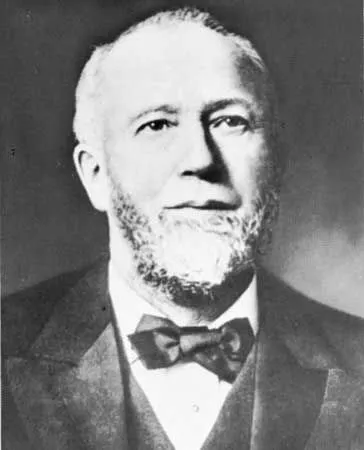 Photo: Gustavus Swift, via cdn.britannica.com
The existing railroads, which had profitable arrangements with cattle shippers who transported live animals, initially refused to carry Swift's refrigerated cars. He went around them, negotiating with smaller lines until the economics became impossible to ignore. By the mid-1880s, refrigerated rail transport was reshaping the American food system from the ground up.
The direct line from Civil War ice logistics to Swift's refrigerated rail network isn't always drawn explicitly in history books, but the connection is real. The war created the first large-scale American infrastructure for moving ice and perishables under pressure. It trained a generation of logistics officers, engineers, and suppliers in the problem of keeping things cold over distance. Swift's innovation didn't emerge from nowhere — it emerged from a country that had just spent four years desperately trying to solve exactly that problem.
From the Railcar to the Refrigerator Aisle
Once refrigerated rail transport existed, centralized food processing and distribution became economically viable. Meatpacking moved to Chicago. Dairy processing consolidated. Produce began traveling from California to the East Coast. The local, daily food market model started its long, slow decline.
The domestic refrigerator — the icebox and its electric successor — followed the same logic into American homes. By the 1920s and 1930s, electric refrigerators were becoming common in middle-class households, and with them came a new way of thinking about food shopping: not as a daily errand but as a weekly project. You bought in volume. You stored it cold. You came back next week.
The supermarket as a format — large, centralized, stocked with goods from across the country — only made sense because the cold chain already existed to supply it. Without refrigerated transport and storage, there was no supermarket. There was just the corner butcher and the morning market.
The Frozen Aisle's Unlikely Origin Story
The Civil War didn't invent refrigeration. Ice had existed forever, and people had been using it to keep food cold for centuries. What the war did was create the pressure, the scale, and the institutional urgency that pushed American engineers and entrepreneurs to solve the long-distance cold transport problem in a serious way.
The soldiers who needed ice for their wounds, the surgeons who demanded it for field hospitals, the logistics officers who had to figure out how to move it by rail in summer — none of them were thinking about grocery stores. They were thinking about survival, about infection rates, about whether the beef would arrive before it turned.
But the infrastructure they built and the problems they solved laid the groundwork for the refrigerated supermarket aisle that Americans now walk past without a second thought. The next time you grab a carton of milk that was processed three states away and will stay fresh for two weeks, that's the very long tail of a wartime emergency — the moment America first had to figure out, under the worst possible conditions, how to keep things cold.