The Architecture of Grief That Built the American Road Trip
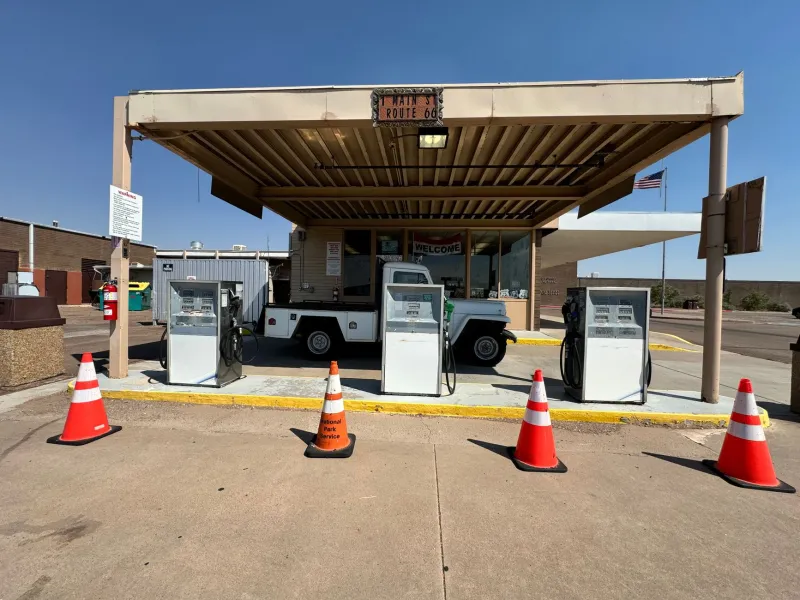
There's a particular geometry to the American gas station that feels completely natural now — so natural that most people never stop to question it. You pull off the road, slide under a canopy, pump your gas, pay, and leave. The flow is smooth, almost choreographed. Vehicles move in and out without confusion. Everything is visible, accessible, and efficient. It feels like the obvious way to design a place where cars stop for fuel.
It wasn't designed for cars at all, though. At least, not originally.
The Problem of Moving Grief Quietly
To understand where the gas station's layout actually came from, you have to go back to the late 19th century and the particular logistical nightmare facing a newly professionalized industry: the American funeral parlor.
Before the Civil War, death was handled at home. Families washed and prepared their own dead, held wakes in the front parlor, and managed the entire process themselves. But the industrialization of death — driven partly by the sheer scale of Civil War casualties, which required embalming and long-distance transport of bodies — created a new professional class: the undertaker, and later the funeral director. These businesses needed physical spaces, and those spaces had a very specific set of requirements.
Funeral parlors in urban areas had to manage the arrival and departure of horse-drawn hearses — and later automobiles — in tight city lots. They needed to move vehicles in and out without attracting excessive attention from the street. They needed covered areas where caskets could be loaded and unloaded regardless of weather. And they needed the entire operation to feel orderly and dignified, because grief doesn't mix well with chaos.
The design solution they arrived at — a covered drive-through approach with clear entry and exit points, a central service area, and sightlines managed to minimize street visibility of the actual transaction — became standard across the funeral industry by the early 1900s.
Enter the Automobile, Looking for a Model
When gasoline-powered automobiles began multiplying across American roads in the first decade of the 20th century, the question of where and how to refuel them was genuinely unsettled. Early motorists bought gasoline from hardware stores, pharmacies, and general goods suppliers — essentially anywhere that stocked it in cans. There was no standard infrastructure, no design template.
The first purpose-built gas stations began appearing around 1905 to 1913, depending on how you define the category. Gulf Oil opened what's often cited as the first drive-in station in Pittsburgh in 1913. The designers of these early facilities faced the same core challenge that funeral parlors had been solving for years: how do you move vehicles efficiently through a confined commercial space, serve them quickly, and send them on their way without creating traffic problems or visual disorder?
 Photo: Gulf Oil, via img.favpng.com
The funeral industry had already done the work. Its canopied drive-through approach, its attendant-at-the-center model, its emphasis on clear entry and exit routing — these weren't just aesthetically borrowed by early gas station designers. They were functionally copied, because they solved an identical spatial problem. The business of death had quietly engineered a template for the business of mobility.
The Canopy as Common Ground
The canopy is perhaps the most direct line of inheritance. Funeral parlors used covered porticos to protect the transfer of caskets from weather and from public view. Gas stations adopted the canopy for weather protection and brand visibility, but the structural logic was the same: create a defined, sheltered zone where the transaction happens, separate from the flow of street traffic.
The attendant island — the central booth or pump island around which vehicles circulate — mirrors the arrangement of funeral parlor service areas, where staff managed the movement of vehicles in relation to a fixed service point. The principle of minimizing driver confusion, of making the correct path through the space intuitively obvious, runs through both designs.
This isn't coincidence. Early 20th century commercial architects frequently worked across multiple industries, adapting successful spatial solutions from one context to another. The funeral parlor was one of the few industries that had genuinely solved the problem of high-volume vehicle management in tight urban spaces before the automobile made that problem universal.
A Design That Defined a Century
The gas station layout that crystallized by the 1920s and 1930s — canopy, central pump island, attendant service, clear in-and-out routing — became so standard that it shaped the entire American experience of the open road. Every cross-country trip, every Route 66 adventure, every family vacation that required a fuel stop was structured by a spatial logic that originated in the management of grief.
Today, the design has evolved — self-service replaced the attendant, convenience stores replaced the service bay, solar panels are appearing on the canopies — but the fundamental geometry remains. Pull in, get what you need, pull out. Clean, efficient, obvious.
Next time you slide under that canopy and reach for the pump, you're participating in a design tradition more than a century old — one that was refined not by automotive engineers, but by the people who figured out, long before cars were common, how to move the heaviest kind of cargo through the smallest kind of space, as quietly and smoothly as possible.