The Hotel Trick That Wired Americans to Stare at Themselves Every Morning
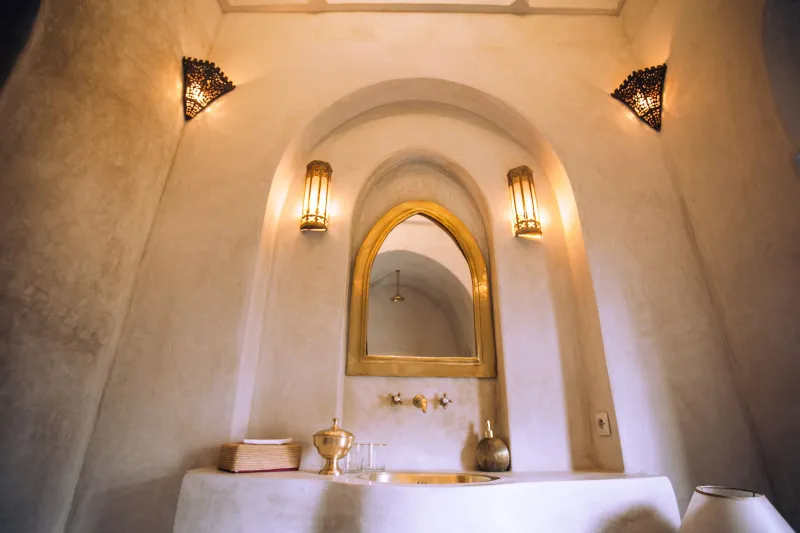
Spend a night in any American hotel and you'll notice something that feels completely natural: a large mirror mounted above the sink, usually framed in something that suggests importance, lit from above or the sides so your face looks its absolute best. You brush your teeth in front of it. You fix your hair. You study yourself for a moment longer than you probably need to. Then you go about your day.
What you almost certainly don't think about is where that ritual came from — or that someone put that mirror there for reasons that had nothing to do with grooming at all.
A Space Problem That Changed Everything
In the mid-1800s, American hotels were in the middle of a fierce reinvention. The grand hotel era was underway, and establishments in cities like New York, Chicago, and Boston were competing hard for wealthy travelers who expected comfort and elegance. The problem was that private bathrooms — still a relatively new concept — were almost universally small. Cramped, dim, and utilitarian, early hotel bathrooms were functional at best.
Hotel designers and decorators borrowed a trick that had been used in European parlors and dining rooms for decades: the strategic mirror. A well-placed looking glass could double the apparent size of a room, bounce light into dark corners, and make the whole space feel less like a closet. It wasn't about vanity. It was about architecture.
Mirrors went up above washbasins because that's where the light source was — usually a gas lamp or, later, an early electric fixture mounted on the wall. The mirror reflected the light back into the room. It made the basin area feel like a destination rather than an afterthought. And almost incidentally, it put your face directly in your line of sight every time you washed your hands.
The Ritual Nobody Planned
Here's where the backstory gets interesting. For most of American history before this period, personal grooming was not a mirror-dependent activity. Hand mirrors existed, of course, and wealthier households had dressing tables with small looking glasses. But the idea of a fixed, large mirror in the room where you washed your face — positioned at eye level and lit for clarity — was genuinely new.
What the hotel industry had accidentally done was create a stage. And Americans, it turned out, were very willing to perform on it.
By the 1880s and 1890s, travelers were returning home from hotel stays with a new expectation baked in. The bathroom mirror wasn't just a feature of fancy hotels anymore — it was starting to feel like a basic requirement. Home design began to follow. As indoor plumbing expanded through American households in the late 19th and early 20th centuries, the fixed bathroom mirror came with it, almost as a default.
Plumbing fixture catalogs from the early 1900s began marketing mirror-and-basin combinations as a single unit. The "lavatory set" — sink, faucet fixtures, and mounted mirror — became the standard package. Builders installed them without much deliberation. Homeowners accepted them without much thought. And just like that, the daily ritual of standing in front of your own reflection while preparing to face the world became hardwired into American domestic life.
Selling the Reflection
The grooming industry noticed. By the 1920s, advertisers had figured out something important: the bathroom mirror wasn't just a mirror. It was a moment of self-evaluation that happened every single morning, reliably, in a private space. That made it enormously useful.
Toothpaste campaigns, shaving cream ads, and early cosmetics marketing all leaned into the mirror moment — the idea that you looked at yourself first thing, assessed what you saw, and reached for a product to improve it. Listerine's famous "halitosis" campaign, which ran from the early 1920s onward and convinced Americans that bad breath was a social catastrophe, was predicated entirely on the assumption that people were already standing in front of a mirror scrutinizing themselves. The mirror didn't create insecurity, exactly. But it gave insecurity a very reliable daily appointment.
The Hollywood beauty industry reinforced all of this. By the 1930s, the "Hollywood vanity" — a dedicated mirror with surrounding light bulbs, borrowed directly from theatrical makeup tables — had become an aspirational object in American bedrooms. The bathroom mirror had spawned an entire category of furniture.
Why It Still Matters
Today, the bathroom mirror is so embedded in American morning life that its absence feels disorienting. Travelers in unfamiliar rentals or older homes sometimes describe feeling genuinely unsettled when a mirror isn't where they expect it to be. We've built elaborate rituals around it — skincare routines, affirmations, the ten-second check before walking out the door.
The wellness industry has turned the mirror moment into something almost philosophical. Influencers talk about "mirror work." Therapists discuss what we see and don't see in our own reflections. The simple act of looking at yourself in the bathroom has accumulated layers of psychological meaning that would have baffled a hotel decorator in 1875, who was really just trying to make a small room feel bigger.
That's the thing about practical solutions. They have a way of becoming cultural institutions before anyone realizes what's happening. A hotel needed to sell the illusion of space. A traveler got used to seeing their own face. A homebuilder included the fixture as standard. An advertiser found the moment irresistible.
And now, every morning, hundreds of millions of Americans stand in front of a mirror above a sink and do exactly what the hotel industry accidentally taught them to do — stare at themselves and decide they're almost ready.