The Symbol That Spent Five Centuries Doing Almost Nothing — Then Became Inescapable
Type your email address right now and you'll use it. Tag someone on Instagram and you'll use it. Send a work message, place an online order, set up any account on any platform anywhere on the internet — and there it is again. The @ symbol is so embedded in modern digital life that it's hard to imagine the internet functioning without it.
Which makes it genuinely strange that for roughly five centuries, almost nobody bothered with it at all.
The Monks Who Started It
The earliest known appearance of @ dates to 1536, in a Florentine merchant's letter. The merchant used it as shorthand for the Italian word anfora — a unit of measurement for large clay jars used to transport goods. The symbol itself likely evolved from a stylized cursive letter "a" with a looping tail, the kind of shorthand that medieval scribes and monks developed to speed up the laborious work of copying manuscripts by hand.
For centuries, @ functioned as a commercial annotation — a quick way to write "at the price of" in trade documents. A merchant might write "10 jars @ 4 ducats" rather than spelling the whole thing out. It was practical, specific, and deeply unglamorous. It appeared in ledgers, shipping manifests, and pricing lists, and almost nowhere else.
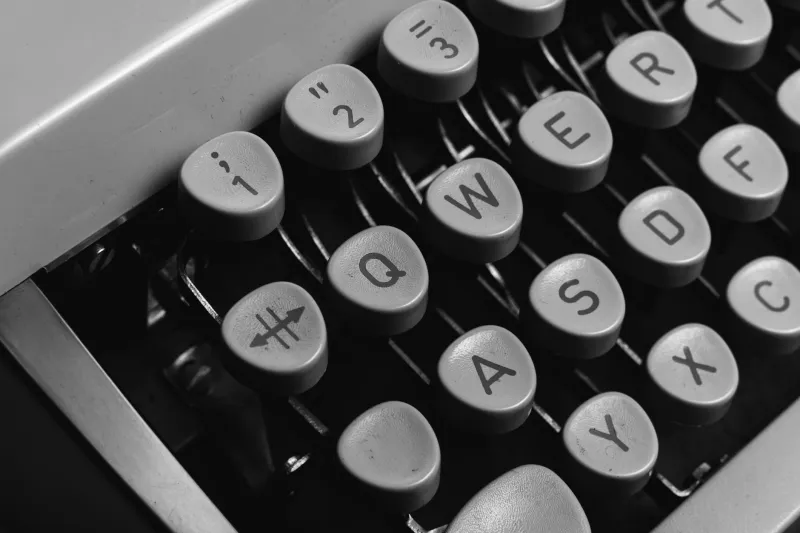
When the typewriter arrived in the 19th century, @ made the keyboard cut — but barely. It earned its spot purely because merchants and accountants needed it for pricing shorthand. It sat on the keyboard like a minor character in a long play, rarely called upon, never quite relevant enough to remove but never important enough to celebrate. Most people who owned typewriters went days, weeks, even months without pressing it once.
The Key Nobody Wanted
By the mid-20th century, @ had survived into the computer age more through inertia than demand. It was on typewriter keyboards, so it ended up on early computer keyboards. No one had a strong reason to include it, but no one had a strong reason to remove it either. It occupied its small corner of the layout and waited.
In 1971, a computer engineer named Ray Tomlinson was working for the research company BBN Technologies in Cambridge, Massachusetts. Tomlinson was part of the team developing ARPANET — the early military and academic network that would eventually evolve into the internet. He was working on a program that would allow users on different computers to send messages to each other, and he needed a way to specify which computer a message was headed to.
 Photo: BBN Technologies, via www.pngkey.com
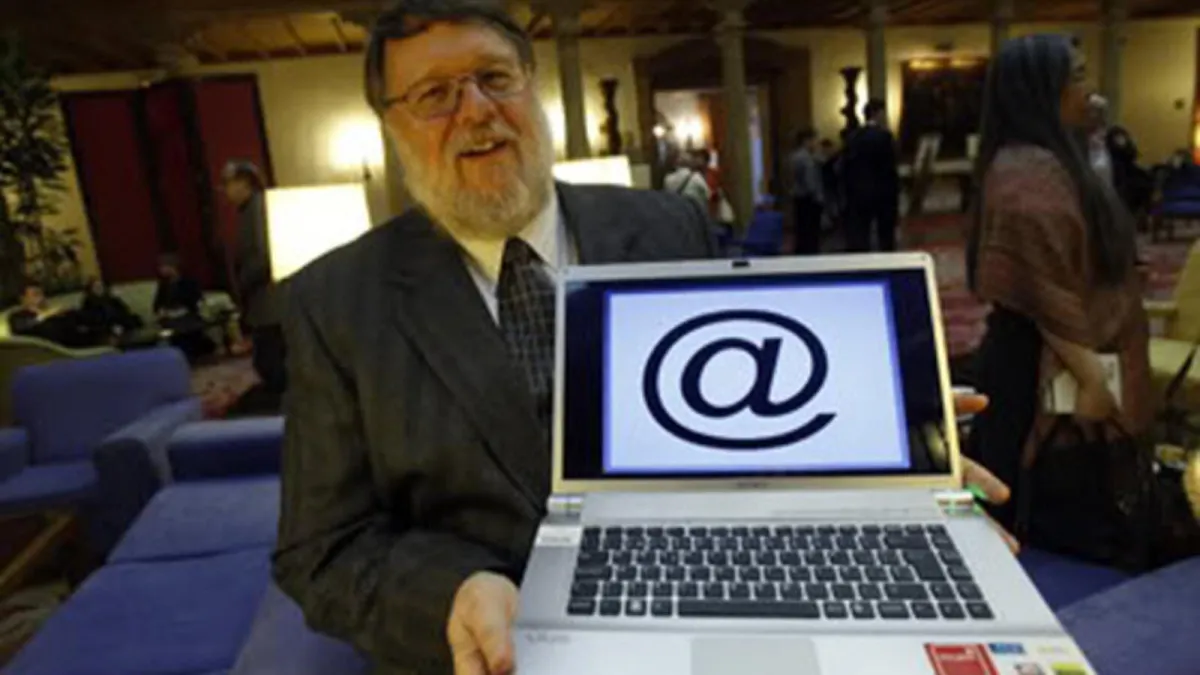 Photo: Ray Tomlinson, via www.albawaba.com
The problem was straightforward: you needed a symbol to separate a user's name from the name of their machine. Something like: username [separator] computer.
Tomlinson looked at the keyboard. He needed a symbol that wouldn't appear in anyone's name — something neutral, something that wasn't already doing an important job somewhere in the code. He ran through the options and landed on @.
His reasoning, by his own later account, was almost embarrassingly practical: it was the least-used key he could find. Nobody had claimed it. Nobody was going to miss it. It was just sitting there, occupying space, having spent its entire five-century career being the symbol you typed when you wanted to say "at the price of" on a shipping invoice.
Tomlinson used @ to send the first email in history — a test message sent from one computer to another in the same room, the contents of which he later described as "completely forgettable" and couldn't recall. The message itself was nothing. The separator was everything.
The Punctuation That Took Over
For most of the 1970s and 1980s, the @ symbol was still a niche character — used in email addresses by researchers, academics, and government workers, but invisible to the general public. The internet hadn't arrived yet. Email was a specialized tool for specialists.
Then the 1990s happened, and everything changed at speed. Email went mainstream. The web arrived. Suddenly, @ was in everyone's address — the unavoidable hyphen between who you were and where your messages lived. Every person who signed up for an AOL account in 1994 typed it. Every Hotmail user in 1997. Every Gmail user from 2004 onward.
Social media added another layer. Twitter's decision to use @ for mentions — @username, pointing directly at a person — gave the symbol a second life as a conversational tool. Instagram followed. Then every other platform. @ stopped being just an address component and became a verb. "I'll @ you in the post." "Don't @ me." The symbol had developed a grammar of its own.
Today, the @ symbol has been formally named by institutions that track these things. It has been added to the permanent collection of the Museum of Modern Art in New York, which acquired it in 2010 as a landmark of design — not a physical object, but a character, recognized for reshaping how human beings communicate.
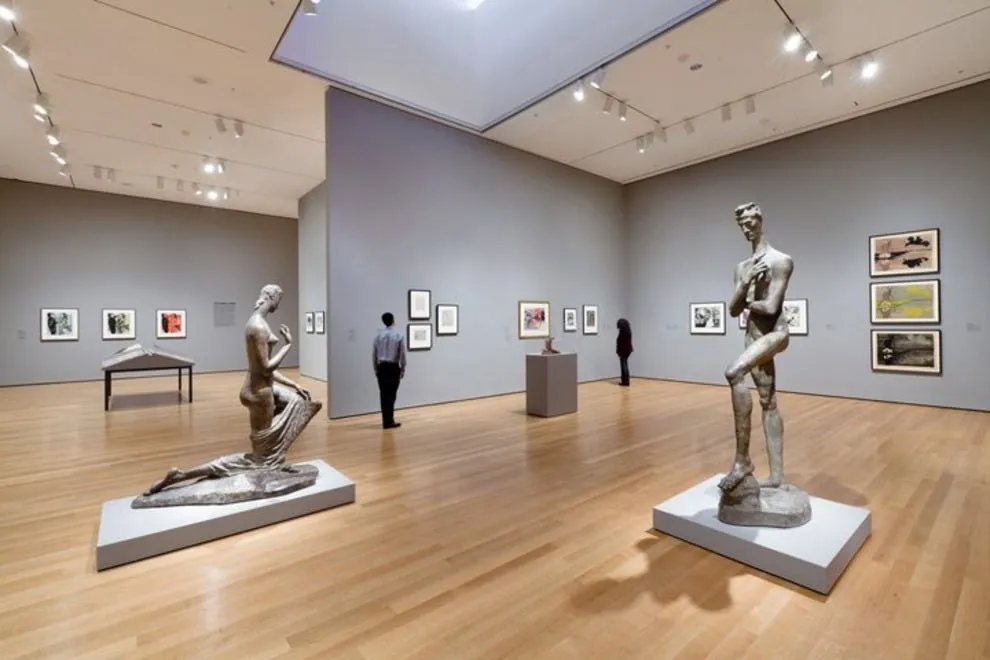 Photo: Museum of Modern Art, via img1.10bestmedia.com
The Accidental Architecture of Modern Life
What Tomlinson chose in 1971 wasn't the result of deep research or careful deliberation. He picked the least-used key on the keyboard because it was available. That's the whole story. A symbol that medieval monks used for wine jars, that typewriter manufacturers included for merchants pricing goods in bulk, that sat dormant on keyboards for decades — became the structural backbone of global digital communication because one engineer needed a separator and @ wasn't busy.
The next time you type your email address, that little curled character is carrying five centuries of obscurity and one very lucky moment of being in the right place at the right time.