The Ink Shortage That Painted America: How a Civil War Supply Problem Gave the Dollar Its Signature Look
When Money Had No Color Rules
Before 1862, American paper money looked like a rainbow exploded in a printing shop. Private banks issued their own currency in every color imaginable — blue, red, yellow, orange — with no standardization and no central oversight. Counterfeiting was rampant, partly because anyone with a decent printing press could create convincing fake bills that looked just different enough from the originals to fool merchants.
Then the Civil War changed everything, including what color money should be.
The Emergency That Demanded Standards
When the federal government needed to finance the Union war effort, Treasury Secretary Salmon P. Chase faced a problem: the country needed a unified national currency, and it needed it fast. The existing system of thousands of different bank notes was chaos — soldiers couldn't spend their pay across state lines, and the government couldn't efficiently collect taxes or pay suppliers.
 Photo: Salmon P. Chase, via www.foodiecrush.com
Congress authorized the first federal paper currency in February 1862, but the Treasury had to figure out how to print millions of bills quickly, securely, and uniformly. This wasn't just a design challenge — it was a logistical nightmare that would accidentally determine what American money looked like for the next century and a half.
The Company With Perfect Timing
Enter the American Bank Note Company, which had been printing currency for private banks since the 1850s. When the Treasury put out contracts for the new federal notes, American Bank Note had something their competitors didn't: massive stockpiles of green ink.
 Photo: American Bank Note Company, via www.nahverkehrhamburg.de
Specifically, they had tons of a green pigment that used a chromium oxide base — a color that was difficult to reproduce photographically with 1860s technology. This wasn't just any green; it was a particular shade that early cameras couldn't capture accurately, making photographic counterfeiting nearly impossible.
The Treasury didn't choose green because it looked presidential or patriotic. They chose it because American Bank Note Company could deliver millions of bills in that color immediately, and because counterfeiters with cameras couldn't replicate it.
The Accidental Brand Identity
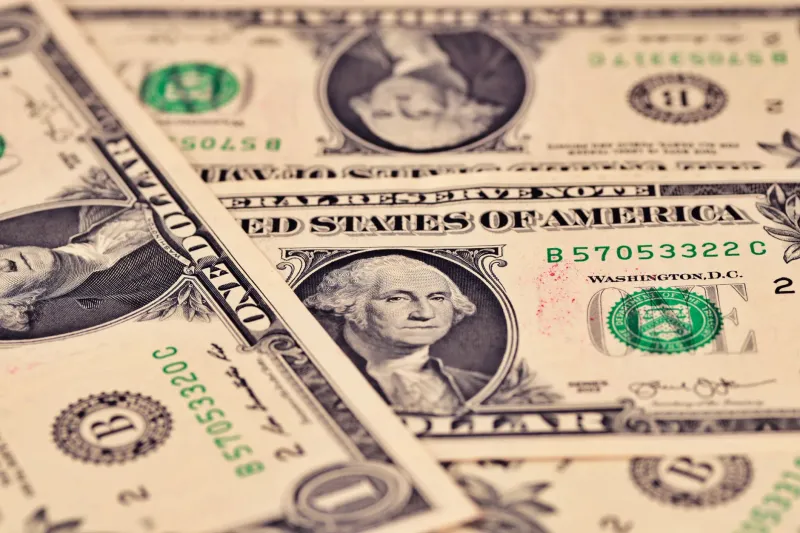
Those first "greenbacks" — as they were quickly nicknamed — were printed with green ink on the reverse side only. The front remained black and white, following traditional engraving practices. But the green backs were distinctive enough that people started calling all federal currency "greenbacks," even though technically only one side was green.
The color choice was so practical that it stuck. When the Treasury redesigned currency in 1869, they kept the green. When they redesigned again in 1886, green remained. By the 1890s, American money was synonymous with green ink, not because anyone planned it that way, but because changing would have required retooling entire printing operations.
When Practical Becomes Permanent
The green standard became so entrenched that even major currency redesigns couldn't escape it. The Federal Reserve Notes introduced in 1914 — still the basis for modern American currency — defaulted to the same green palette. Designers had decades to choose any color scheme they wanted, but green had become "what money looks like."
This wasn't just aesthetic inertia. By the early 20th century, green had become psychologically associated with value and stability. Changing the color would have meant convincing millions of Americans to trust money that didn't look like money.
The Color That Conquered the World
The accidental success of green American currency influenced global finance in ways the Civil War-era Treasury never imagined. As the dollar became the world's reserve currency after World War II, green became internationally associated with financial power and stability.
Today, when countries design new currencies, they often include green elements specifically because people worldwide associate that color with monetary value. The European Union's euro notes include green denominations, and many developing countries incorporate green into their currency designs to suggest stability and international acceptability.
Why Change Never Happened
The U.S. Treasury has redesigned currency multiple times since 1862, adding security features, updating portraits, and incorporating new anti-counterfeiting technology. But they've never seriously considered abandoning green ink. Every focus group and market research study confirms the same thing: Americans expect money to be green.
Even when the Treasury introduced color-shifting inks and subtle background colors in recent redesigns, they kept the dominant green palette. The 2004 twenty-dollar bill added peach and blue accents, but the overwhelming impression remained green. It's as if the entire American economy is built on the assumption that money should look the way it accidentally started looking in 1862.
The Mistake That Became Law
Today, federal law doesn't actually require American currency to be green — that's just how it's always been done. The Treasury could theoretically print money in any color, but they won't, because green has become more than just ink. It's become the visual representation of American financial credibility.
A Civil War emergency created a color association so powerful that "greenback" remains slang for American money 160 years later. What started as a practical printing decision — use the ink we have in stock — accidentally created one of the world's strongest brand identities. And all because one company happened to have a lot of green pigment when the government desperately needed to print money fast.