Built for the Bomb, Decorated for the Big Game: The Strange Second Life of America's Finished Basement
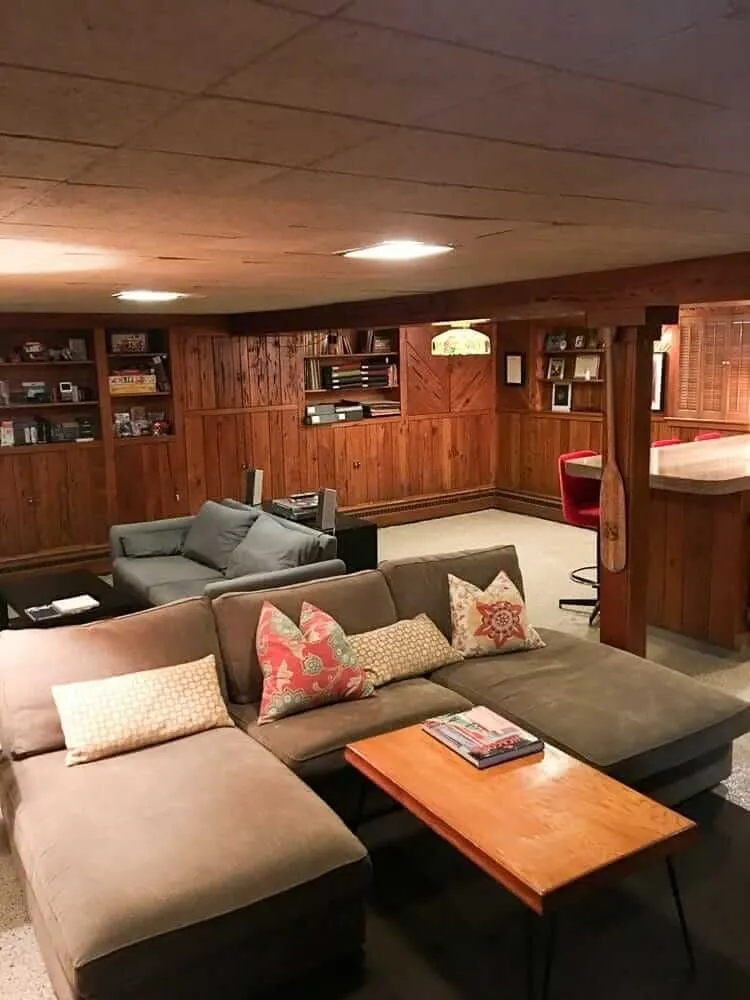
Photo: retro American basement rec room wood paneling vintage furniture, via i.pinimg.com
Built for the Bomb, Decorated for the Big Game: The Strange Second Life of America's Finished Basement
Go down into almost any American basement built between 1955 and 1975 and you will find the same things: low ceilings, wood-paneled walls, a bathroom that nobody uses, and a general atmosphere of cheerful gloom. Maybe there's a bar cart that hasn't moved since 1987. Maybe there's a pool table with a slightly warped felt surface. Maybe there's a television so large it could only have been carried down those stairs by four determined adults.
This room has a dozen names — the rec room, the rumpus room, the man cave, the finished basement. What it almost never gets called is what it was originally designed to be: a nuclear fallout shelter.
The American finished basement has anxious origins. And the story of how a room built for surviving catastrophe became the place we watch football and store Christmas decorations is stranger than the décor suggests.
The Federal Government Enters the Home Improvement Business
In the early 1950s, the United States government was in an uncomfortable position. The Soviet Union had tested its first atomic bomb in 1949. The Cold War was no longer theoretical. And the official response — delivered through the Federal Civil Defense Administration, established in 1950 — involved asking ordinary American homeowners to take personal responsibility for surviving a nuclear attack.
This was, to put it gently, an ambitious ask.
The FCDA launched a sustained public education campaign that included pamphlets, films, and advice columns explaining how American families could survive nuclear fallout by sheltering in place. The iconic Duck and Cover film featuring Bert the Turtle was part of this effort, aimed at schoolchildren. But for homeowners, the message was more specific: your basement, properly prepared, could protect your family.
Government publications distributed through the late 1950s described exactly what a home fallout shelter should contain. Two weeks' worth of canned food. Water stored in sealed containers. A battery-powered radio for emergency broadcasts. A first aid kit. Blankets. A portable toilet. The shelter didn't need to be elaborate — it just needed to be underground, where the earth itself would absorb radiation.
For a brief, strange window in American history, digging out and reinforcing your basement was an act of civic responsibility.
Suburban Builders Spot an Opportunity
The postwar American suburbs were expanding at a rate that would be difficult to overstate. The GI Bill had made homeownership accessible to a generation of veterans, and builders like William Levitt were constructing entire communities from scratch across Long Island, Pennsylvania, and New Jersey. Millions of new homes needed basements — and the civil defense movement had just given those basements a specific, urgent purpose.
 Photo: Long Island, via cdn.britannica.com
Homebuilders and contractors quickly realized that the fallout shelter pitch was also an excellent selling point. A reinforced concrete basement with thick walls and limited window exposure wasn't just a survival space — it was a feature. Advertisements in home-improvement magazines began describing finished basements as dual-purpose investments: practical protection for your family, and additional living space for everyday use.
The logic was sensible enough. If you were going to reinforce the space anyway, why not make it comfortable? Why not add paneling, a drop ceiling to hide the pipes, some carpet, maybe a wet bar? The shelter became a room. The room needed furniture. The furniture needed a television.
By the late 1950s and early 1960s, the basement had become one of the most heavily marketed spaces in American domestic life — sold simultaneously as a safety measure and a lifestyle upgrade.
The Pivot Nobody Had to Announce
The Cuban Missile Crisis of 1962 represented peak Cold War anxiety for American civilians. Fallout shelter construction spiked. Sales of canned goods and portable radios surged. For approximately two weeks in October, the American public genuinely believed they might need to use these rooms.
 Photo: Cuban Missile Crisis, via images.fineartamerica.com
And then the crisis passed. And then the years went on. And gradually, without any official announcement or cultural moment marking the transition, the fallout shelter stopped being a fallout shelter.
The canned goods got eaten or thrown out. The transistor radio got replaced by a stereo system. The folding cots gave way to a sofa. The space that had been stocked for the end of the world became the space where the kids played on weekends, where teenagers retreated for privacy, where adults set up the bar cart and watched the game.
This transition happened so organically that it left almost no historical trace. Families didn't hold ceremonies to mark the moment their shelter became a rec room. They just gradually moved different things into it.
The Room That Remembers
The design fingerprints of the fallout shelter era are still visible in finished basements across America, if you know what you're looking at. The low drop ceilings were originally practical — they concealed pipes and wiring while also reducing the volume of space that needed to be heated and filtered in an emergency. The wood paneling that covers so many basement walls served as insulation as much as decoration. The small, high windows — often barely large enough to qualify as windows at all — were a deliberate design choice to limit radiation exposure.
Even the tendency to install a second bathroom in the basement has civil defense roots. Extended shelter occupancy required sanitation facilities. The half-bath that now exists primarily for guests at Super Bowl parties was originally intended for a very different kind of extended stay.
What We Store in the Survival Room
Today the finished basement exists in a kind of comfortable cultural limbo. It's too useful to ignore and too weird to fully explain. We fill it with the overflow of ordinary life — the holiday decorations, the exercise equipment we stopped using, the board games missing one piece, the children's artwork we can't throw away but don't want to display.
Occasionally, in certain corners of the internet, the basement's Cold War origins get rediscovered and people express mild surprise. Then they go back to watching the game.
There is something almost poetic about the fact that a room designed to help Americans survive the worst imaginable scenario became the place where Americans go to relax most completely. The fallout shelter and the man cave are, in the end, both answers to the same question: where do you go when you need to shut out the world?