The Hum You Stopped Hearing: How Fluorescent Light Quietly Took Over the American Workplace
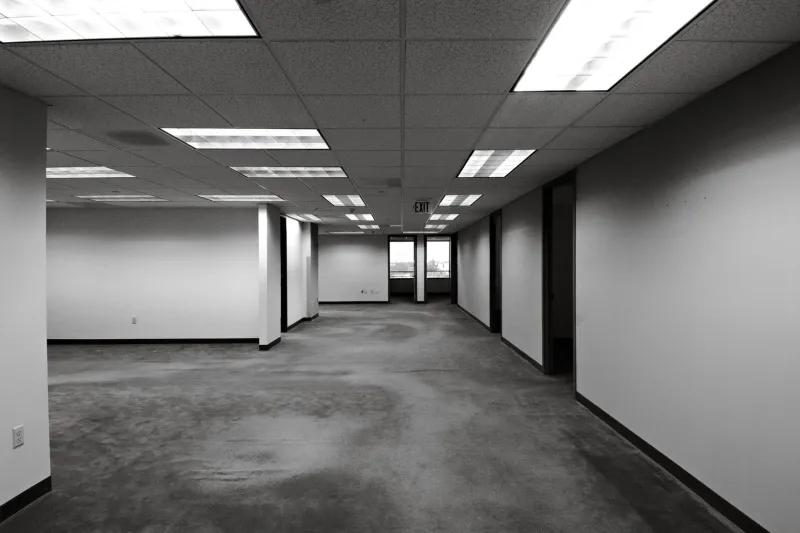
There's a particular quality to the light in an American office building that you don't notice until you leave. Step outside after eight hours under fluorescent tubes and the sunlight feels almost aggressive in its warmth. Go back inside and something settles over you — a flatness, a faint visual fatigue — that you've probably learned to call Tuesday.
Fluorescent lighting is so embedded in the American indoor environment that most people never think to question it. It came with the building. It was there before you arrived. It will be there after you leave. But it wasn't inevitable. It was a choice — made once, in a specific moment, for specific reasons — and then never really unmade.
The Invention That Waited Decades to Matter
The basic science behind fluorescent lighting is older than most people realize. Researchers had understood that certain gases, when excited by electricity, would emit light without the heat and waste of an incandescent bulb. Experiments with gas-discharge lamps date back to the 1850s. But turning that knowledge into something practical and cheap enough to install at scale took almost a century.
General Electric and Westinghouse both cracked the commercial version in the late 1930s, introducing fluorescent tube fixtures that were dramatically more energy-efficient than incandescent bulbs — roughly four to five times more output per watt. They debuted at the 1939 World's Fair in New York, gleaming under their own cool light, symbols of the modern future.
For a few years, adoption was modest. The fixtures were more expensive upfront. The light looked strange. People weren't sure they liked it.
Then the war started, and nobody asked anymore.
The Factory Logic That Changed Everything
World War II transformed American manufacturing almost overnight. Factories that had been making automobiles were retooled to make tanks. Plants that had never run past 5 PM were now operating around the clock, three shifts a day. The pressure to produce — ammunition, aircraft parts, uniforms, equipment — was total.
In that context, lighting became a productivity variable. Factory managers and industrial engineers discovered that fluorescent lighting let workers see more clearly for longer. It reduced eye strain on assembly lines. It lit large floor spaces evenly without the shadows that incandescent bulbs cast. And crucially, it cost less to run, which mattered when you were burning electricity 24 hours a day.
By the mid-1940s, fluorescent lighting was standard in American war production facilities. Hundreds of thousands of workers spent their shifts under those long white tubes. The technology stopped feeling strange and started feeling like simply what a working environment looked like.
From Factory Floor to Office Tower
After the war, America built. Office buildings, government facilities, schools, hospitals — the postwar construction boom was enormous, and the architects and developers designing those spaces had a ready answer for lighting. Fluorescent fixtures were efficient, they were proven, and they were now being manufactured at scale, which brought the cost down further.
The drop ceiling, another postwar innovation, was practically designed around fluorescent tubes. Those suspended grid ceilings with removable tiles existed partly to allow easy access to the mechanical systems above — and partly because they made fluorescent fixture installation trivially simple. The two technologies co-evolved, each making the other more practical.
By the 1960s, the fluorescent office was the default American office. Not because anyone had decided it was the best environment for human beings to spend eight hours in. Because it was cheap, efficient, and already everywhere.
The Body Keeps the Score
It took decades for researchers to start asking what all that exposure was actually doing to people. The findings were not entirely reassuring.
Fluorescent lights flicker — not visibly, but at a frequency that some people's nervous systems register. Early fluorescent ballasts operated at 60 Hz, cycling fast enough that most people couldn't consciously detect it but slow enough to cause headaches and eye strain in sensitive individuals. Newer electronic ballasts run much faster and have reduced this problem, but older fixtures — still common in plenty of American buildings — haven't been replaced.
The color spectrum is another issue. Fluorescent light is weighted toward certain wavelengths and lacks the full range of natural daylight. Research over the past 30 years has linked prolonged exposure to artificial light lacking natural spectrum to disrupted circadian rhythms, mood effects, and reduced alertness. The irony is pointed: lighting installed to maximize productivity may, over a full workday, be undermining it.
Studies on workplace wellness began noting in the 1990s and 2000s that access to natural light was one of the strongest predictors of employee satisfaction and performance. Windows became a premium feature in office design. The open-plan office, for all its other problems, at least got light closer to more desks.
The Slow Retreat
LED technology has been gradually displacing fluorescent lighting since the 2010s, and the shift has accelerated as LED costs have dropped. LEDs are more efficient, longer-lasting, and — critically — tunable. You can adjust their color temperature to mimic natural daylight, or shift warmer in the evening to reduce the sleep-disrupting effects of blue-spectrum light.
But the fluorescent fixture is not gone. Walk into any older school, municipal building, or mid-tier office park and you'll find them still humming away, casting that familiar flat white light over people who've long since stopped noticing it.
That's the most revealing part of this story. Fluorescent lighting conquered the American workplace not because it was ideal, but because it arrived at the right moment with the right economics. The war needed it. The postwar building boom embedded it. And once something is everywhere, questioning it starts to feel like questioning the floor.
The hum was always there. Most of us just learned not to hear it.