The Luggage Revolution Nobody Planned: How Hotel Staff Accidentally Taught America to Pack Light
When Traveling Meant Bringing Your Entire Wardrobe
Picture this: It's 1895, and you're taking a train from Boston to San Francisco. You're not packing a carry-on and a checked bag. You're bringing steamer trunks—plural. Multiple enormous wooden chests filled with enough clothing for every possible social situation you might encounter during your month-long journey.
This was normal. Expected, even.
Wealthy Americans traveled like they were moving house. Men packed formal wear, casual wear, sporting clothes, and evening dress. Women brought entirely separate wardrobes for morning, afternoon, and evening, plus specialized outfits for different climates and activities.
A typical well-to-do family might travel with six to eight pieces of luggage, each weighing 60 to 80 pounds when full.
The Grand Hotels Create a Problem
As America's railroad network expanded, magnificent hotels rose up to serve the new class of leisure travelers. The Palmer House in Chicago, the Willard in Washington D.C., the Palace Hotel in San Francisco—these weren't just places to sleep. They were destinations in themselves, with marble lobbies, crystal chandeliers, and an army of uniformed staff.
 Photo: Palace Hotel, via service.ravensburger.de
 Photo: Palmer House, via cf2.ppt-online.org
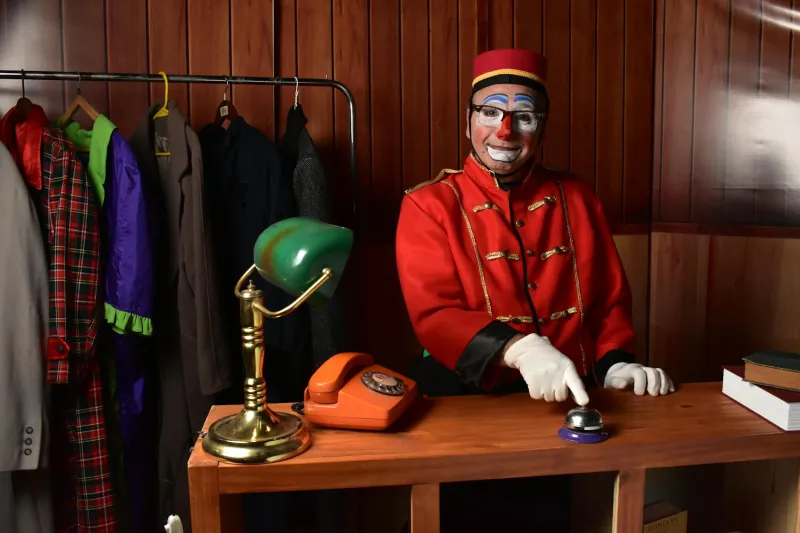
Including bellhops.
The job of bellhop was created specifically to handle the luggage crisis. These weren't just bag carriers—they were skilled professionals who could navigate narrow staircases, crowded lobbies, and temperamental elevators while managing enormous loads of passenger belongings.
But here's where things got interesting: bellhops were paid per service, not per hour. The more trips they had to make to transport a single guest's luggage, the more time they lost that could have been spent helping other customers.
The Subtle Art of Luggage Shaming
Bellhops developed strategies. Not official policies—nothing written down—but informal techniques for encouraging guests to travel lighter.
They would sigh audibly when confronted with excessive luggage. They'd ask pointed questions: "All of this for one guest?" They'd make multiple trips very slowly, ensuring other guests had to wait. Some would even "accidentally" bump trunks against marble pillars, creating loud noises that drew attention.
Most effectively, they'd charge extra for "excessive handling." While hotels advertised free luggage service, bellhops found creative ways to impose additional fees for guests who brought too much stuff.
Guests began to notice that travelers with fewer, lighter bags received faster, more cheerful service.
The Social Pressure of Public Spaces
Those grand hotel lobbies weren't just beautiful—they were theaters. Every arrival and departure was a public performance, watched by other guests, hotel staff, and local society figures who used the lobby as an informal social club.
Being seen struggling with excessive luggage became embarrassing. Guests began to associate multiple trunks with being nouveau riche, unsophisticated, or simply trying too hard.
The social elite started to pride themselves on traveling efficiently. "I can manage a week in Newport with just two bags" became a form of subtle bragging.
The Bellhop Economy Changes Everything
By the 1910s, hotels were employing hundreds of bellhops in major cities. These workers developed their own informal networks, sharing information about which guests tipped well and which ones were more trouble than they were worth.
Guests who consistently traveled light gained reputations as "good" customers. They received better room assignments, faster service, and more personal attention. Word spread through social circles: packing less meant being treated better.
Meanwhile, hotels began to quietly encourage this trend. Lighter luggage meant faster check-ins, less wear and tear on elevators, and fewer complaints about slow service.
The Unexpected Alliance
Something remarkable happened: travelers and hotel staff found themselves on the same side. Both groups benefited when guests brought less stuff.
Guests discovered that traveling light was actually more pleasant. They could move through stations and hotels more easily. They worried less about lost belongings. They could be more spontaneous with their itineraries.
Hotel staff could provide better service when they weren't overwhelmed with luggage logistics.
This created a feedback loop. As service improved for light travelers, more guests began to pack less. As more guests packed less, hotels could focus on service quality rather than luggage management.
The Philosophy Emerges
By the 1920s, travel writers were promoting light packing as a virtue in itself. Magazine articles appeared with titles like "The Art of Traveling Smart" and "Why Less Is More on the Road."
What had started as a practical response to bellhop economics evolved into a travel philosophy. Americans began to see excessive luggage as a sign of poor planning, not prosperity.
This was revolutionary. For centuries, traveling with lots of belongings had been a status symbol. Now, traveling with less was becoming the mark of a sophisticated traveler.
The Lasting Impact
When commercial aviation emerged in the 1950s, Americans were already culturally prepared for luggage restrictions. The idea that you should pack only what you truly needed wasn't imposed by airlines—it was a value the hotel industry had already instilled.
Today's minimalist travel movement, carry-on-only culture, and even Marie Kondo's organizing philosophy all trace back to those marble hotel lobbies where bellhops first taught Americans that bringing less stuff could actually improve your experience.
The next time you're trying to fit everything into a carry-on bag, remember: you're participating in a cultural shift that began more than a century ago, when hotel workers figured out that the best way to improve service was to convince guests they didn't need all that stuff in the first place.
Sometimes the most profound changes in how we live happen not through grand design, but through the accumulated small pressures of daily interactions. In this case, the simple economics of bellhop service quietly revolutionized how an entire culture thinks about travel.
And we never even noticed it happening.